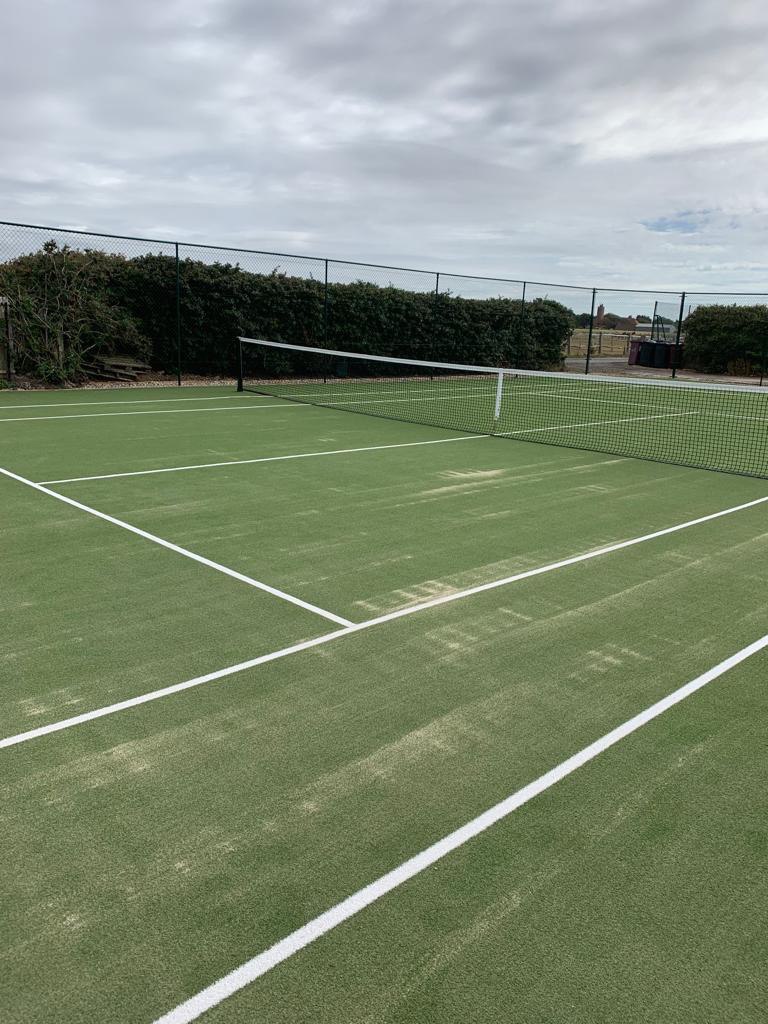
Constructing a new tennis court involves considerably more than creating a level area and applying a playing surface. The quality and long-term performance of the finished court depend heavily on decisions made before surfacing begins, including the suitability of the site, ground preparation, drainage, levels, base construction and the intended use of the facility.
A well-planned tennis court should provide consistent playing characteristics while remaining practical to maintain and appropriate for its surroundings. If important groundwork or drainage requirements are overlooked, problems can eventually become visible at surface level through standing water, uneven areas, cracking or premature deterioration.
For new tennis court construction projects in Dorset, UK, careful preparation is therefore fundamental. Assessing the site and establishing the correct construction requirements before work begins provides a much stronger foundation for a dependable finished court.
What Needs to Be Planned Before Building a New Tennis Court?
Every tennis court construction project should begin with an assessment of how the proposed court will be built, used and maintained. Site conditions can vary significantly, so the construction method should reflect the individual location rather than relying on a standard approach without proper assessment.
Important considerations include:
- The available space and proposed court position
- Existing ground conditions
- Site levels and required excavation
- Drainage requirements
- Base and sub-base construction
- Surface specification
- Intended frequency and type of use
- Access for construction equipment
- Surrounding ground and vegetation
- Fencing and court access
- Future maintenance requirements
- The relationship between groundwork and final playing quality
Planning these elements together can prevent individual parts of the project from conflicting later in the construction process.
Start With a Proper Site Assessment
Before construction begins, the proposed location needs to be understood properly.
A site that appears relatively flat may still contain changes in level that become significant across the full dimensions of a tennis court. Ground conditions can also influence how much preparation is required before the structural layers are installed.
A professional site assessment provides an opportunity to identify these factors before machinery and materials arrive.
The aim is to establish what needs to happen beneath the finished surface rather than focusing only on how the completed court will look.
Available Space Needs to Be Considered Carefully
The playing area is only one part of the space required for a functional tennis court.
Players need appropriate room around the marked court, while fencing, access and surrounding features also need consideration.
Trying to force a court into an unsuitable area can compromise its practical use.
The position should therefore be planned according to the complete facility rather than simply measuring whether the basic playing lines will fit within the available ground.
Good planning at this stage can create a more comfortable and usable court once construction is complete.
Court Position Can Affect the Overall Project
Where the tennis court sits within the available site can influence several parts of the construction process.
Existing slopes, surrounding ground, vegetation and access can all affect the work required.
Positioning the court appropriately may make it easier to establish suitable levels and manage water effectively.
Conversely, choosing a location based purely on appearance without considering ground conditions can introduce unnecessary construction difficulties.
The most obvious location is therefore not always automatically the most suitable.
Ground Conditions Need to Be Understood
The finished playing surface depends heavily on the ground supporting it.
If underlying material is unstable or unsuitable, simply placing new construction layers above it does not necessarily remove the problem.
Ground preparation needs to create a reliable platform for the court.
The exact requirements depend on what is found during assessment.
This is one reason professional tennis court construction should begin below surface level. A visually impressive finish cannot compensate for inadequate preparation underneath.
Excavation Creates the Starting Point for Construction
Once the site has been assessed and the required levels established, excavation can prepare the area for the structural layers of the court.
The depth and extent of excavation should reflect the construction specification and existing ground conditions.
This stage needs to be carried out accurately.
Removing too little unsuitable material can leave weaknesses beneath the court, while inconsistent preparation can create variations in support.
The objective is to produce a suitable formation on which the remainder of the court can be constructed systematically.
A Tennis Court Needs a Reliable Foundation
The base beneath a tennis court performs an essential structural role.
It distributes loads and provides stable support for the playing surface above.
If this foundation is poorly constructed, problems may eventually appear at surface level even if the initial finish looks excellent.
Movement beneath the court can contribute to unevenness and deterioration.
Professional construction therefore places significant emphasis on the layers that players will never see once the project has been completed.
A durable playing surface begins with dependable groundwork.
Compaction Is an Important Part of Base Preparation
Placing suitable material is only part of constructing a reliable base.
It also needs to be properly compacted.
Insufficient compaction can allow material to settle after construction, potentially creating changes in surface level.
Consistent preparation across the court helps provide more uniform support.
This is particularly important because even relatively small variations can become noticeable across a large, flat playing area.
Compaction should therefore be treated as an integral construction stage rather than a minor part of the groundwork.
Drainage Should Be Planned From the Beginning
Water management is one of the most important considerations in outdoor tennis court construction.
Rainfall needs somewhere appropriate to go.
If drainage is treated as an afterthought, the completed court may experience standing water or persistent wet areas.
The correct approach depends on the individual site and the proposed court construction.
Drainage planning should therefore take place alongside decisions about levels and groundwork rather than after the surface has already been installed.
A properly considered system helps the entire court work as one construction.
Surrounding Ground Can Influence Water Movement
Water does not only fall directly onto the playing surface.
The land surrounding the court can also influence how moisture behaves.
If nearby ground directs water towards the facility, the court may experience additional demands that need to be considered during construction.
This is why site assessment extends beyond the exact dimensions of the playing area.
Understanding how the wider ground behaves can help determine the most appropriate drainage and level strategy.
Ignoring surrounding conditions can leave a well-built surface dealing with water that was never properly accounted for.
Surface Levels Need to Be Accurate
A tennis court needs carefully controlled levels.
The surface should support effective drainage while also providing the consistent playing area required for tennis.
Creating these conditions requires precision throughout the groundwork and base construction.
Errors at an early stage can be difficult to correct simply by adjusting the final surface.
Levels should therefore be established and maintained throughout the construction process.
This provides a much stronger basis for an even, predictable finished court.
The Surface Should Match the Intended Use
Not every tennis court is used in exactly the same way.
A private court may experience different levels of use from a facility intended for frequent organised play.
The intended use should therefore form part of the initial construction discussion.
Surface characteristics, expected usage and maintenance requirements can all influence the most suitable specification.
Choosing the surface should not be treated purely as a visual decision.
It forms part of the wider court system and should work with the base, drainage and intended playing requirements.
Playing Consistency Starts Below the Surface
Players experience the final surface, but many aspects of court performance are determined underneath it.
A well-prepared base helps provide consistent support across the playing area.
If different sections settle or move differently, the surface may eventually become less uniform.
This can affect both appearance and play.
The construction process should therefore aim for consistency from the formation upwards.
Good tennis court construction is a layered process in which every stage contributes to the finished result.
Existing Slopes Require Careful Planning
Not every available site begins as a naturally level platform.
Where the ground slopes, additional preparation may be required to establish the correct court formation.
The extent of this work depends on the characteristics of the site.
Attempting to follow the existing ground without proper planning can create unsuitable court levels or drainage difficulties.
Professional assessment allows the required earthworks and preparation to be understood before construction begins.
This can prevent significant changes from becoming necessary after work is already underway.
Access for Construction Should Be Considered Early
Tennis court construction involves moving materials and equipment to the site.
The route available for this work can influence how the project is organised.
Restricted or awkward access should be identified before construction starts rather than discovered when excavation or material delivery is already required.
Planning access early allows the construction process to be arranged more efficiently around the characteristics of the property.
It also helps ensure that the practical requirements of building the court have been considered alongside the finished design.
Surrounding Trees and Vegetation Should Be Assessed
Trees, hedges and other vegetation can influence the environment around an outdoor tennis court.
Overhanging growth can deposit leaves and organic material onto the surface, while surrounding vegetation can affect shade and moisture retention.
The objective is not necessarily to remove vegetation from around the proposed site.
Instead, its relationship with the future court should be understood during planning.
Considering surrounding growth early can make routine court maintenance more manageable once the facility is in use.
Court Fencing Should Be Integrated Into the Design
Fencing is an important practical feature of many tennis courts.
It helps contain balls within the playing area and defines the court boundary.
Its position should therefore be considered as part of the overall design rather than added without reference to the rest of the facility.
Gate positions and player access also need to work comfortably with the court layout.
Planning these features at the construction stage can produce a more coherent finished facility.
Player Access Should Be Practical
A new tennis court should be easy to enter and leave without interfering unnecessarily with the playing area.
The route from the surrounding property to the court and the position of access gates can influence everyday usability.
These details may seem relatively minor compared with excavation and surfacing, but they affect how practical the finished facility feels.
Considering them before construction allows access to become an integrated part of the project rather than an adjustment made afterwards.
The Court Should Fit Its Surroundings
A tennis court is a substantial outdoor feature.
Its design should therefore consider how it relates to the available site.
The position, surrounding space, fencing and access should work together rather than appearing as unrelated components.
This does not mean sacrificing playing quality for appearance.
Instead, good planning can create a court that performs properly while fitting naturally within the space available.
A professional construction approach considers both technical requirements and practical integration.
Future Maintenance Should Influence Construction Decisions
Every outdoor tennis court requires some level of ongoing maintenance.
Thinking about this before construction can help make future care more manageable.
Drainage needs to remain functional, surfaces should be kept appropriately clean, and surrounding vegetation may require management.
The choice of construction and surface specification can also influence maintenance requirements.
A court should therefore be designed not only for the day it is completed but for how it will be used and maintained afterwards.
Water Pooling Should Not Be Accepted as Normal
Persistent standing water on a newly constructed court can indicate that levels or drainage are not functioning as intended.
Although any outdoor surface will become wet during rainfall, water should be managed as part of the overall design.
This is why drainage cannot be separated from groundwork.
If the base and finished levels have not been constructed appropriately, surface treatments alone may not correct the underlying cause of persistent pooling.
Proper water management begins during initial construction.
Surface Cracking Can Begin With Problems Below
When cracking develops on a court, attention naturally focuses on the visible surface.
However, the cause can sometimes originate beneath it.
Movement, settlement or inadequate support within lower construction layers can eventually be reflected through the playing surface.
Simply treating a visible crack may therefore fail to address the reason it developed.
For new construction, the most effective approach is prevention through suitable ground preparation, base construction and compaction.
The quality of the hidden layers has a direct influence on how the finished court performs over time.
Resurfacing Cannot Correct Every Construction Problem
A worn playing surface can often be renewed when the underlying court remains structurally suitable.
However, resurfacing is not a substitute for proper initial construction.
If significant movement, poor levels or inadequate drainage originate within the base, applying another surface above them may leave the underlying problem unresolved.
For a new tennis court project, investing attention in the groundwork from the outset helps avoid relying on surface treatments to compensate for structural weaknesses later.
Good Construction Requires the Stages to Work Together
A tennis court should not be viewed as a collection of independent tasks.
Excavation influences the base. The base influences surface stability. Levels affect drainage. Drainage affects how quickly the playing area can recover following rainfall.
Each stage is connected.
A weakness in one part can influence the performance of another.
Professional tennis court construction therefore requires coordination throughout the project rather than treating groundwork, drainage and surfacing as unrelated operations.
Avoid Focusing Only on the Finished Appearance
The visible surface is naturally one of the most exciting parts of a new tennis court project.
However, it represents only the final stage of a much larger construction process.
A smooth new surface can initially look impressive regardless of what lies beneath it.
The real test comes as the court experiences changing weather and repeated use.
For this reason, decisions should not be based solely on appearance. Preparation, support, levels and drainage are fundamental to the quality of the completed facility.
Site-Specific Construction Is Important
Two tennis courts may look very similar when finished while requiring different preparation beneath the surface.
Ground conditions, gradients, drainage and access can vary considerably between sites.
A construction specification should therefore respond to the location rather than assuming that every project requires exactly the same groundwork.
Site-specific planning allows potential difficulties to be identified and incorporated into the construction approach before they become problems.
Professional Planning Can Prevent Avoidable Problems
Many problems that become visible on an established court can be traced back to earlier construction stages.
Uneven areas, water pooling and premature surface deterioration may have causes below the finished playing layer.
Professional planning aims to address these potential weaknesses before they become hidden beneath the completed court.
This makes the early assessment and groundwork stages particularly valuable.
The objective is not simply to build a court that looks finished quickly, but to create a facility in which each layer has been prepared for its intended role.
Tennis Court Construction in Dorset, UK
For property owners and organisations planning a new tennis court in Dorset, UK, the construction process should begin with a careful assessment of the proposed site.
At Tennis Court Construction Dorset, we can assess the ground, levels, drainage requirements, access and intended use before determining an appropriate construction approach.
From groundwork and base preparation through to drainage and the finished playing surface, each stage can be planned as part of the complete court rather than treated separately.
The aim is to create a practical, well-prepared tennis facility that is suited to its site and intended use.
Conclusion
Before starting a new tennis court construction project, it is important to consider much more than the final playing surface.
Site suitability, ground conditions, excavation, base construction, compaction, levels, drainage, access, fencing and intended use all influence the quality of the finished court. Decisions made during these early stages can have a direct effect on surface consistency, water management and future maintenance.
Most importantly, a tennis court should be constructed as a complete system. A high-quality surface cannot compensate for inadequate foundations or poorly planned drainage beneath it.
If you are considering a new tennis court construction project in Dorset, UK, contact Tennis Court Construction Dorset. We can assess the proposed site and recommend an appropriate construction approach based on the ground conditions, intended use and requirements of the facility.
Call us on: 01202 125699
Click here to find out more about Tennis Court Construction Dorset
Click here to complete our contact form and see how we can help with your tennis needs.